System Architecture
Tileverse is designed as a collection of loosely coupled, composable libraries. While they work seamlessly together, each module acts as a standalone tool for its specific domain (I/O, Tiling, Encodings).
Module map
The Tileverse monorepo ships six modules. Four are independent of each other; tileverse-tilestore builds on the format and grid libraries; tileverse-pmtiles is the only module that strictly depends on all the others (tileverse-storage for I/O, tileverse-vectortiles for MVT decoding, tileverse-tilematrixset for grid math, tileverse-tilestore for the high-level tile-store wrappers).
graph TD
subgraph "Application Layer"
App[User Application]
end
subgraph "Independent Modules"
ST[tileverse-storage<br/>Storage + RangeReader]
VT[tileverse-vectortiles]
TMS[tileverse-tilematrixset]
end
subgraph "Cross-cutting"
TS[tileverse-tilestore<br/>TileStore<T>]
end
subgraph "Composed Modules"
PMT[tileverse-pmtiles]
end
App --> ST
App --> VT
App --> TMS
App --> TS
App --> PMT
TS --> VT
TS --> TMS
PMT --> ST
PMT --> VT
PMT --> TMS
PMT --> TSSystem context
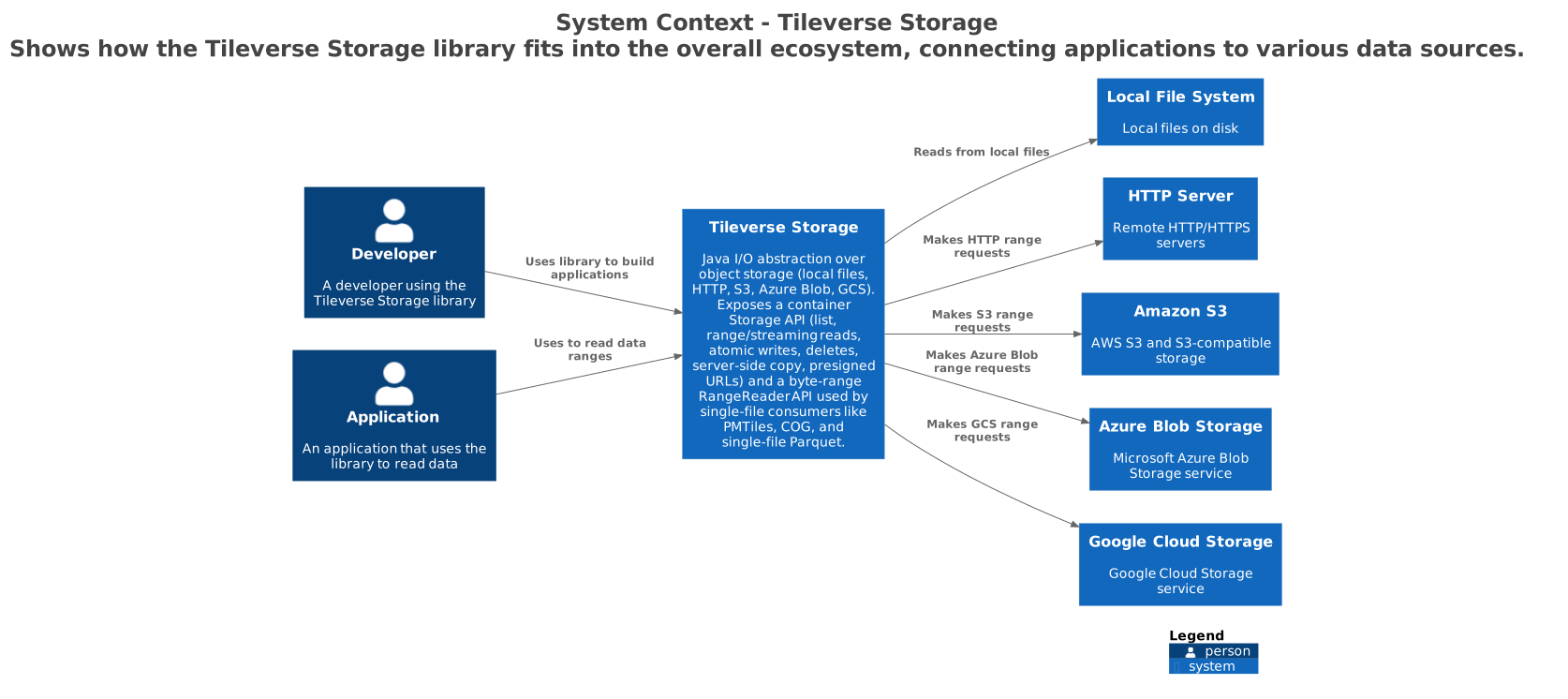
The Tileverse system sits between consumer applications and the four external storage families it speaks to (local FS, HTTP, S3-compatible object stores, Azure, GCS).
Container view
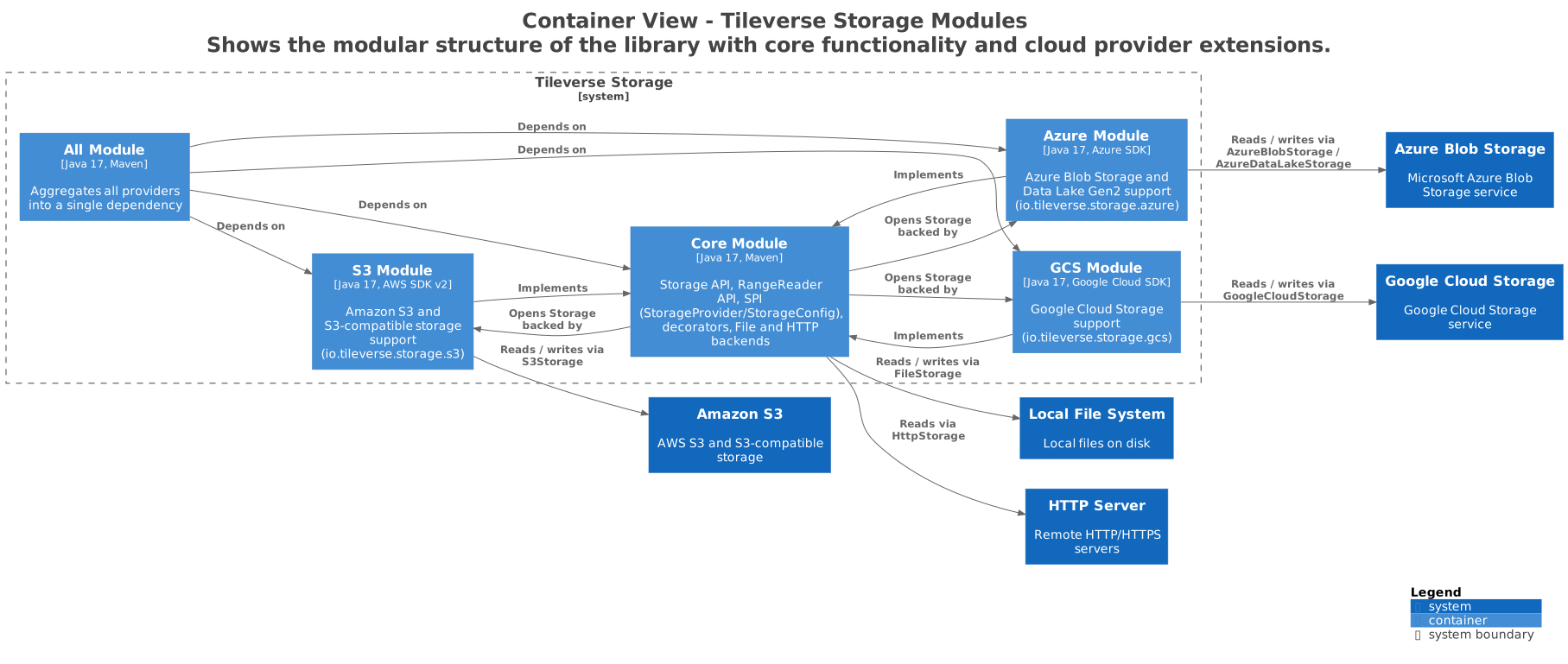
All six monorepo modules plus their dependencies on each other and on the external storage systems. tileverse-pmtiles is the only module that depends on every other Tileverse module; tileverse-tilestore brings the format-agnostic TileStore<T> abstraction; the four storage containers (-core, -s3, -azure, -gcs) compose under -all for callers that want every backend at once.
Per-module C4 component views are embedded in each library's section:
- Storage core internals
- PMTiles internals
- Vector Tiles internals
- Tile Matrix Set internals
- Tile Stores internals
All C4 diagrams are generated from docs/structurizr/workspace.dsl via docs/build.sh (Docker required). Edit the DSL and rerun the build to regenerate.
Design Philosophy
1. I/O Independence (tileverse-storage)
We treat data access as a distinct problem from data format.
- Goal: Read (and write, list, copy, presign) bytes from anywhere (S3, HTTP, Azure, GCS, File) efficiently.
- Anti-Pattern: Format libraries (like a GeoTIFF reader) implementing their own S3 clients.
- Solution:
Storageprovides a unified container API; itsRangeReaderAPI exposes the byte-range read surface used by single-file consumers (PMTiles, COG, single-file Parquet).
2. Pure Mathematical Models (tilematrixset)
Spatial reference systems and grid logic are kept separate from data storage.
- Goal: Calculate tile coordinates and bounding boxes without external dependencies.
- Benefit: Can be used by a tile server to calculate grids even if the data source isn't Java-based or uses a different I/O library.
3. Format Specificity (vectortiles, pmtiles)
These libraries handle the parsing and encoding logic for specific file specs.
- Vector Tiles: Pure Protocol Buffers / JTS transcoding. No I/O logic.
- PMTiles: Orchestrates
RangeReaderto fetch specific directory bytes, usesVectorTilesto parse the result, andTileMatrixSetto understand the grid.
Integration Patterns
Direct Usage
Applications often use modules directly:
- ETL Pipelines: Use
vectortilesto convert PostGIS geometry to MVT bytes. - Tile Servers: Use
tilematrixsetto calculate which tiles cover a viewport. - Data Access: Use
tileverse-storage(itsRangeReaderAPI) to fetch partial content from Cloud Optimized GeoTIFFs (COGs) stored on S3.
Composed Usage
The pmtiles library demonstrates the power of composition:
- Accepts a
RangeReaderinterface (polymorphic backend). - Uses
HilbertCurve(internal) for index lookup. - Returns raw bytes at the reader level; high-level
*TileStorewrappers decode on the fly:PMTilesVectorTileStoreusesvectortilesto return parsedVectorTileobjects,PMTilesRasterTileStoreusesjavax.imageio.ImageIOto return decodedRenderedImageobjects. Both run their decoder against the streamingInputStreamoverload so no intermediateByteBufferis allocated per tile.