Tile Stores Reference
PMTilesReader.getTile(...) returns raw on-disk tile bytes. The *TileStore classes wrap a PMTilesReader and expose a uniform, format-agnostic API parameterized on the decoded payload type. They live in the tileverse-tilestore module and are pulled in transitively when you depend on tileverse-pmtiles; no separate dependency is needed.
This page is the API reference. For task-oriented walkthroughs see Reading PMTiles.
Component view
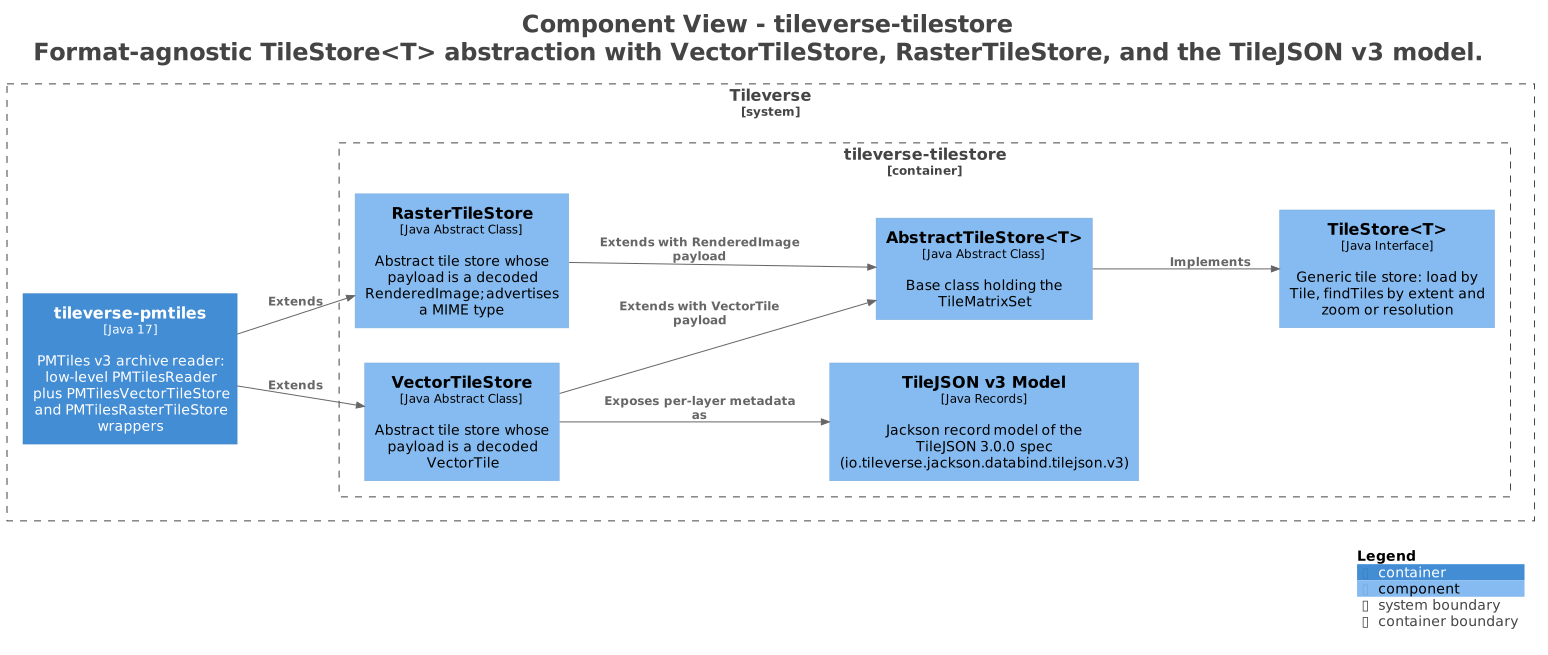
TileStore<T> is the format-agnostic top-level interface; AbstractTileStore<T> owns the TileMatrixSet. VectorTileStore and RasterTileStore are payload-specific abstract bases that PMTiles (and any future archive format) implements. The TileJSON v3 Model records expose per-layer metadata advertised by vector archives.
Module layout
| Package | Type | Purpose |
|---|---|---|
io.tileverse.tiling.store | TileStore<T> | Top-level interface: query by extent, by zoom, or one tile at a time. |
io.tileverse.tiling.store | AbstractTileStore<T> | Base class that owns the TileMatrixSet. |
io.tileverse.tiling.store | TileData<T> | Record pairing a Tile (spatial metadata) with its decoded payload. |
io.tileverse.vectortile.store | VectorTileStore | Abstract base for stores whose payload is a decoded VectorTile. |
io.tileverse.rastertile.store | RasterTileStore | Abstract base for stores whose payload is a decoded RenderedImage. |
io.tileverse.pmtiles.store | PMTilesVectorTileStore | PMTiles archive whose tileType == TILETYPE_MVT. |
io.tileverse.pmtiles.store | PMTilesRasterTileStore | PMTiles archive whose tileType == TILETYPE_{PNG,JPEG,WEBP,AVIF}. |
io.tileverse.jackson.databind.tilejson.v3 | TileJSON, VectorLayer, TilesetType | TileJSON 3.0.0 model exposed by VectorTileStore.getVectorLayersMetadata() and produced by serializers. |
TileStore<T>
public interface TileStore<T> {
    enum Strategy { SPEED, QUALITY }

    TileMatrixSet matrixSet();
    Optional<TileData<T>> loadTile(Tile tile);
    default Optional<TileData<T>> findTile(TileIndex tileIndex);

    default Stream<TileData<T>> findTiles(List<BoundingBox2D> extents, int zoomLevel);
    default Stream<TileData<T>> findTiles(List<BoundingBox2D> extents, double resolution, Strategy strategy);
    default Optional<TileMatrix> tileMatrix(List<BoundingBox2D> extents, int zoomLevel);
    default int findBestZoomLevel(double resolution, Strategy strategy);
}
matrixSet()returns the store's grid model. For PMTiles this is alwaysWebMercatorQuad.loadTile(Tile)is the single primitive every subclass implements. Default methods compose it.findTile(TileIndex)resolves the index through the matrix set and loads that tile.findTilesresolves a list of extents to the intersecting tile range and streams decoded payloads.Strategycontrols zoom selection when a target resolution falls between matrix levels.SPEEDrounds to the coarser zoom (fewer reads),QUALITYrounds to the finer zoom (more detail).
TileData<T>
Tile holds spatial metadata (extent in CRS units, TileIndex, the parent TileMatrix). data is the decoded payload of type T. Useful when a consumer needs the extent to position the tile in a mosaic without re-deriving it.
VectorTileStore
public abstract class VectorTileStore extends AbstractTileStore<VectorTile> {
    public abstract List<VectorLayer> getVectorLayersMetadata();
    public Optional<VectorLayer> getLayerMetadata(String layerId);
    public abstract BoundingBox2D getExtent();
}
getVectorLayersMetadata()returns the TileJSON 3.0.0vector_layersarray advertised by the archive (layer id, field types, zoom range).getExtent()is the WGS84 bounding box of the archive, useful for clipping queries.
PMTilesVectorTileStore implements this on top of a PMTilesReader. It validates the archive's tileType at construction and throws UnsupportedTileTypeException if the archive is a raster archive.
RasterTileStore
public abstract class RasterTileStore extends AbstractTileStore<RenderedImage> {
    public abstract String mimeType();
    public abstract BoundingBox2D getExtent();
}
mimeType()returns the on-disk MIME type of the encoded tiles (image/png,image/jpeg,image/webp,image/avif). Useful for HTTPContent-Typeheaders when proxying raw bytes, or for selecting anImageWriterwhen re-encoding.- The payload type is the
RenderedImageinterface (not the concreteBufferedImagethatImageIO.readproduces). The result flows directly into APIs likeGridCoverageFactory.create(String, RenderedImage, ReferencedEnvelope)without intermediate copies.
PMTilesRasterTileStore implements this on top of a PMTilesReader. It decodes each tile by feeding the streaming InputStream returned by PMTilesReader.getTile(long, IOFunction<InputStream, D>) directly to ImageIO.read. No intermediate ByteBuffer is allocated per tile.
WebP decoding is enabled out of the box by a bundled ImageIO plugin (com.github.usefulness:webp-imageio) registered via the JDK ServiceLoader. PNG and JPEG decoders ship with the JDK. AVIF is not bundled; add a JDK ImageIO plugin for AVIF if you need it.
PMTilesVectorTileStore / PMTilesRasterTileStore
Both wrappers are constructed from an existing PMTilesReader. They borrow the reader; closing the wrapper is not required (no resources beyond the underlying reader), but closing the reader releases the storage handle.
try (PMTilesReader reader = PMTilesReader.open(uri)) {
    PMTilesVectorTileStore vectorStore = new PMTilesVectorTileStore(reader);
    // or
    PMTilesRasterTileStore rasterStore = new PMTilesRasterTileStore(reader);
}
If the archive type doesn't match the wrapper, the constructor throws UnsupportedTileTypeException. Callers can branch on PMTilesHeader.isRasterTileType() to pick the right wrapper:
PMTilesHeader header = reader.getHeader();
TileStore<?> store = header.isRasterTileType()
        ? new PMTilesRasterTileStore(reader)
        : new PMTilesVectorTileStore(reader);
Optional caching: both classes expose a fluent cacheManager(CacheManager) setter that attaches an io.tileverse.cache.CacheManager for memoizing decoded payloads at the store level. The default is no cache.
TileJSON v3 model
The io.tileverse.jackson.databind.tilejson.v3 package contains a Jackson-annotated record model of the TileJSON 3.0.0 specification:
| Type | Role |
|---|---|
TileJSON | Top-level record. Required fields: tilejson, tiles, vector_layers. Optional: attribution, bounds, center, description, etc. |
VectorLayer | Per-layer descriptor: id, fields, description, minzoom, maxzoom. Returned by VectorTileStore.getVectorLayersMetadata(). |
TilesetType | Enum: OVERLAY or BASELAYER, serialized as the JSON-spec strings. |
The records use Jackson annotations directly; no custom mapper is required. The package is consumed by VectorTileStore and is the format the PMTiles reader pulls per-layer metadata from when present in the archive's JSON metadata blob.